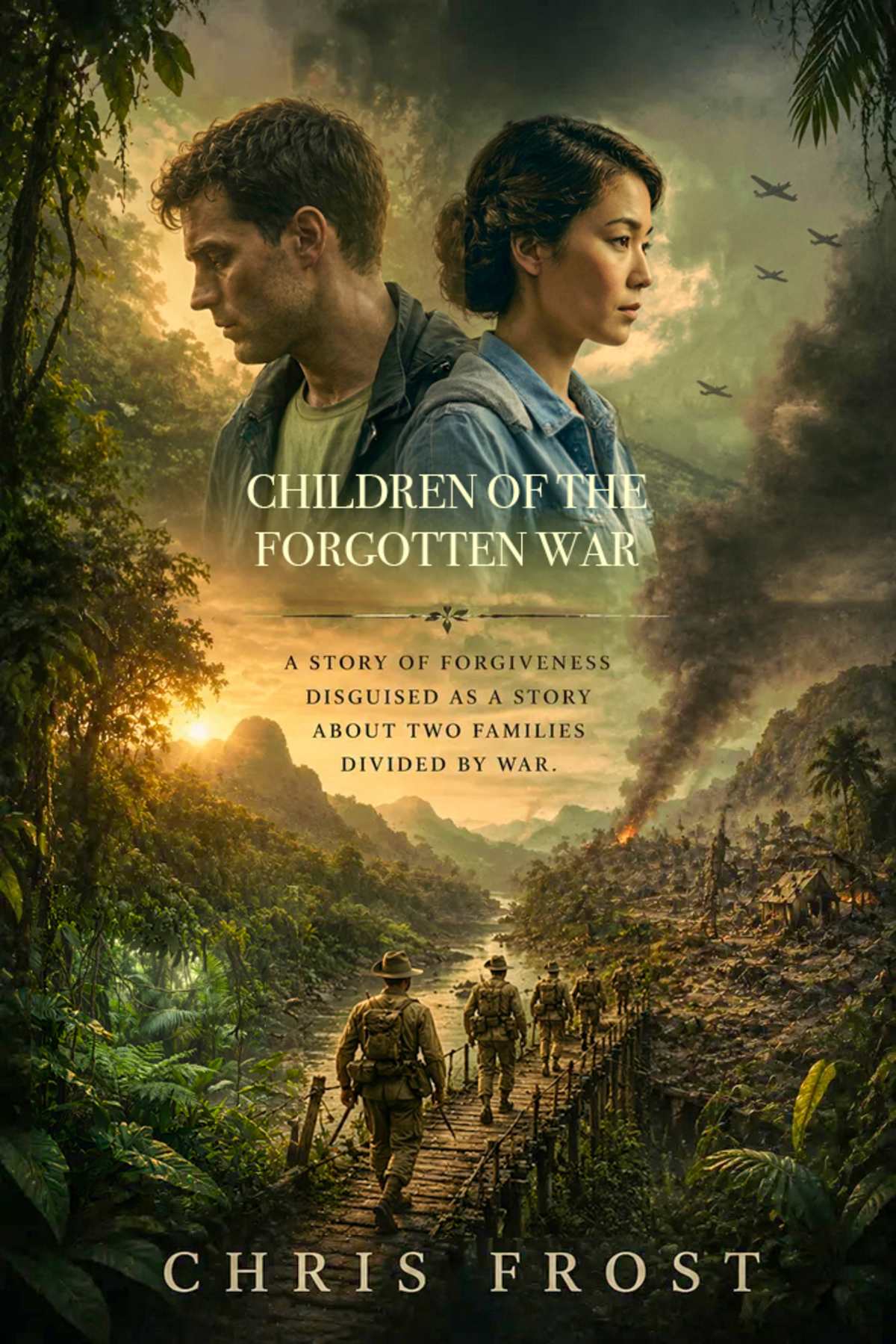
CHILDREN OF THE FORGOTTEN WAR
A book about forgiveness disguised as a story about two families divided by war.
Historical fiction, 109,000 words (complete, in final edit phase)
In 1943, in the hills of Burma, a badly wounded British officer looks up at the enemy soldier standing over him with a raised pistol. Some would call what happens next murder. This is the story of what it cost both families to find out it was mercy.
Short pitch
In 1943, in the hills of Burma, a badly wounded British officer looks up at the enemy soldier standing over him with a raised pistol. Some would call what happens next murder. CHILDREN OF THE FORGOTTEN WAR asks whether it was mercy.
The story begins, as it will end, in London: in 1989, when James Dillon falls in love with Masako Takahashi, neither knowing their grandfathers were friends in pre-war Japan, or that their fathers fought on opposite sides in the war that produced that single, unbearable shot. When Masako discovers her father may have fired it, killing James’s uncle, she fears the past will overshadow their relationship and ends their engagement rather than let it. Two retired intelligence officers, one British, one Japanese, help them uncover the truth: a wartime killing that was also an act of mercy, and the life-saving deed two years later that made James’s own existence possible.
Long pitch
In 1943, in the hills of Burma, a badly wounded British officer looks up at the enemy soldier standing over him with a raised pistol. Some would call what happens next murder. CHILDREN OF THE FORGOTTEN WAR asks whether it was mercy.
The story begins, as it will end, in London. In 1989, James Dillon and Masako Takahashi meet by chance in the National Gallery and fall in love, unaware of any connection between their families.
That connection reaches back to 1907, when a young British Army doctor, Edward Dillon, struck up a friendship with a Japanese innkeeper, Kanou Takahashi, while travelling through Japan. Both men married soon after and raised sons of their own, Edward with Mary, an Irish-American orphan he met in Dublin; Kanou with Hara, a nurse he met by chance on a train. Neither imagined that, one day, those sons would fight each other in the hills of Burma, or that a single act of mercy in the middle of that war would one day make James’s own existence possible.
Back in London, fifty years on, James and Masako’s romance survives his mother’s undisguised hostility, right up until Masako discovers that her father may have killed James’s uncle in that same war. She ends their engagement rather than let that history reach into his family.
With the help of a retired British intelligence officer and a former Kempeitai officer, both of whom served alongside their fathers, James and Masako track down the last living witnesses on both sides of the war. What they uncover, a killing that was mercy and a mercy that was a rescue, will either destroy their future, or give both families, after fifty years, a reason to finally forgive.
Comparable titles
Min Jin Lee, Pachinko: a multi-generational family saga spanning decades and continents, for the reader drawn to ambitious scope.
David Guterson, Snow Falling on Cedars: Japanese-American reconciliation in the aftermath of WWII, told through moral complexity rather than easy judgement.
Cecily Blench, The Long Journey Home: the same war, the same country (Burma, 1941), and the same emotional register.
Synopsis
In 1943, in the hills of Burma, a badly wounded British officer looks up at the enemy soldier standing over him with a raised pistol. Some would call what happens next murder. This is the story of what it cost both families to find out it was mercy.
1989, London:
James Dillon, an erudite British barrister, meets Masako Takahashi, a formidable Japanese banker, by chance in the National Gallery. Eventually, their attraction deepens into love, and they become engaged, despite the hostility of James’s mother, who cannot forgive the Japanese for what Burma did to her family.
As their relationship deepens, an old photograph album and a watch handed down from Masako’s late father begin to surface a connection between their families reaching back to 1907, when Edward Dillon, a young British Army doctor, and Kanou Takahashi, a Japanese innkeeper, became friends at a mountain ryokan beneath Mount Fuji. The friendship lasted thirty years. Both men married soon after: Edward to Mary Ryan, an American orphan he met in Dublin; Kanou to Hara, a nurse he met by chance on a train. Both raised sons who would one day fight on opposite sides of a war.
During the Burma campaign, tragedy engulfs each family. In 1943, Edward’s youngest son, Peter, is reported missing. Refusing to accept his loss, Mary insists that her surviving son, John, use every contact he has to discover whether his brother is alive or dead, a demand that draws John into the search for the truth. A year later, Kanou’s eldest son is also killed. His brother exacts revenge on unarmed British medics. Rumours, secrecy, and grief leave both households bound to wounds that never heal.
Masako carries her own inheritance of silence. Her father returned from Burma consumed by guilt and trauma before taking his own life when she was nine. Determined to escape that legacy, she has built a disciplined life in London. Yet the deeper she and James investigate, the more she fears what the past may demand of them.
Former soldiers from both sides reveal fragments of what followed a clash in Burma, where James’s uncle, mortally wounded and beyond saving, was killed. Masako’s discovery that her father was involved threatens to destroy their relationship and confirm James’s mother’s deepest convictions.
Fearing the truth will destroy their relationship, Masako breaks off their engagement.
Heartbroken, James turns to a retired British Army intelligence officer who once served with his father. HIS investigation leads to a former Kempeitai officer who worked with him and James’s father in Saigon. Together they uncover the final truth: James’s uncle’s death was an act of compassion to end the suffering of a mortally wounded man. They also discover that, two years later in Saigon, Masako’s father risked his life to save James’s father from an assassination attempt, an act without which James himself would never have been born.
Beneath the mountains where their grandfathers first met, the two families gather for James and Masako’s wedding. Sarah, convinced that her late husband would have welcomed Masako, is determined to do her duty and attend, even as she refuses to relinquish her own hatred of the Japanese. It is only when veterans from both sides lay the whole truth before her, the killing that was mercy, and the rescue that followed it, that her journey towards forgiveness truly begins.